
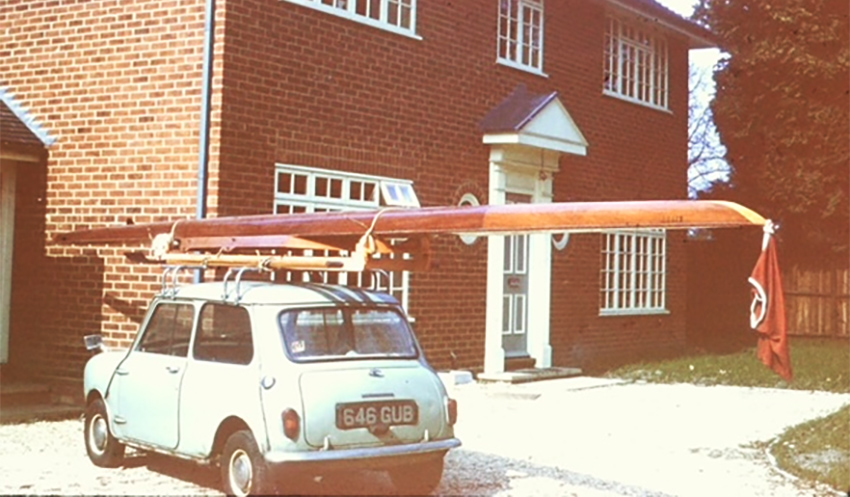
Like many of us who bought our first car in the late 60’s/early 70’s mine was a Mini. GUB 646 was bought from Dave Thornhill (CH 65-69) in 1971 when I was at Manchester University, where Dave was also a student. He no longer had need of it and was prepared to sell it for £75 (I think. I cannot remember how many miles it had done but i found out years later at an OS September weekend that he and Rob Jones (Ch65-69) had driven to Greece and back in it. Reliability was never a strong point of British cars of that era and I quickly had to learn how to service it, change shock absorbers, bleed breaks, replace dynamos, replace the cylinder hear including manually grinding in the valves and dealing with problems of water in the footwell and the heater being inadequate. Years later whilst working as a factory tour guide at BMW- Mini in Oxford when showing older mini enthusiasts round, we would hardly get past the first stop without discussing the thickness of feeler gauge used to adjust the points or some other such technical nicety.
Inevitably, GUB did not last long before falling apart largely with rust and needed replacing. I bought a Renault 4, (SYC 135G) complete with umbrella gearstick and dashboard hand break. In many ways a far more practical car, despite its tendency to overheat, solved by removing the thermostat. I even attached a towbar so that I could tow the University Club trailer with a coxless four so that we could compete at Henley. The Renault 4 was certainly fun to drive swaying around all over the road or possibly that was my driving.
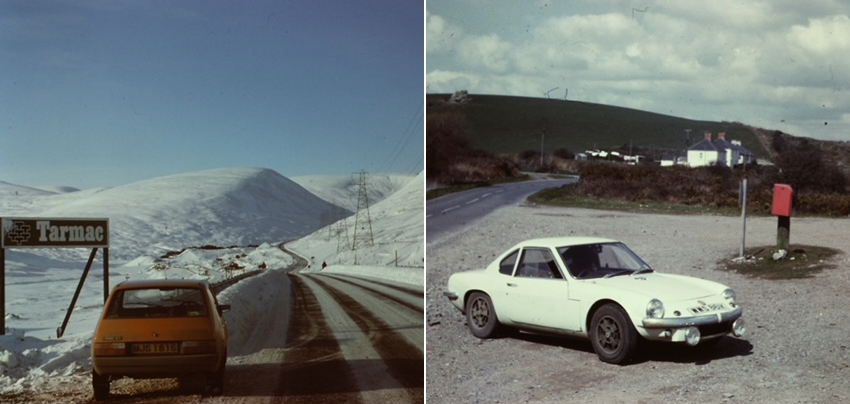
My first job was with a firm of Architects and Planners based in Dingwall, Ross-shire. The Renault was a great car to have in the highlands with its rough farm tracks and narrow roads. On a Friday after work, we would adjourn to the National Hotel for a pint or too before going home and then on out. One winter’s evening when there was snow and ice on the road and after probably more than a couple of pints, I thought I would see how fast I could drive home on a narrow back road before coming off. At 45 mph I duly ended up in the ditch. Fortunately, a land rover came along a few minutes later towed me out, Renault 4s were very light cars, so I proceeded onwards at 40mph with no further mishap.
At the time the firm were doing rather well as a result of a boom in North Sea oil related developments and were offering generous car loans which naturally I took advantage of. I acquired a Ginetta G15. Ginetta was at that time a small company based in Suffolk making specialist sports cars usually in kit form. The G15 had a hillman Imp 875cc engine in the rear, a glass fibre body, parts from the Triumph Spitfire and VW Beetle amongst others. Mine had been assembled by the original owner. This consisted of little more than; bolting on the wheels, buying and attaching a battery and putting on the fan belt. It was fast, fun and very fancy looking. I got it up to 100mph on the Nairn straight. Its weakness was the cv joints between the engine and the rear wheels were rubber and took the shape of and called donuts. These regularly broke. However, with the aid of two spanners I could mount it on a curb and replace one in under 15 minutes.
The impracticality of such a car meant that I continued to hold on to the Renault 4. However, rust was taking its toll. To get it through its last MOT I had to lift it up on a fork lift and rivet sheets of steel onto the underside of the floor then slapping some black paint on it. I doubt if such an approach would work today. As I was returning to university to do a Master’s course in September 1976, I realised I couldn’t afford two cars and needed something more practical and economic. The answer was a Renault 5. It was a good a relatively reliable car even if not the most fun to drive. After I finished the course and was back in work, I upgraded it to a Renault 5 GTL. This had a 1300cc engine which gave it a relatively high torque that was used to make it economical in terms of fuel consumption but not very exciting to drive.
By the late 1970’s I was working for the Highlands and Islands Development Board (HIDB) in Inverness and driving high mileages handing out grants. As this was paid for, there where advantages in having a larger car due to a higher mileage allowance, hence a Triumph Dolomite. Today, such cars in good condition can be much sought after. Despite its good looks, reliability was not a strong point and repairs included having the warped cylinder head skimmed. I only kept it for a few months before returning to the Renault stable.
A bright orange Renault 14 was next on the list. A good solid family car is the best way of describing it. My main memory of it is the starter motor sticking and having to carry a hammer and iron chisel to hit it with to free it up until I could afford to replace it.
The shortness of the previous paragraph probably sums up my feelings towards the Renault 14. This was followed by a couple of Citroen Visas. The first was a GT. The build/material quality is best exemplified by the tachometer needle melting in the sun one particularly hot day. However, the experience encouraged me to buy the more powerful and trendy GTi. The mid 80’s was the era of “hot Hatchbacks” The VW Golf GTi and the Peugeot 205 GTi being amongst most popular. Citroen’s offering the Visa GTi shared the same engine as the Peugeot but lacked the “Je ne sais quoi”. Having four doors and 16-inch wheels as compared to the Peugeot’s 2 and 17 respectively, the handling wasn’t quite as good. Having test driven it I was a bit concerned about whether I could put the driver’s seat far enough back being 6’2”’. I was assured by the garage they could move the runners back so I agreed a price. When I went to pick it up and pay That alteration hadn’t happened so I walked out saying I didn’t want it. Within half an hour of my getting back home the garage had phoned me to say they had managed to do it.
After the Citroen, I went up market with a Volvo 480. Every so often Volvo make a foray into the “Sports Car” market. The 480 was seen as being a successor to the P1800 made famous by the TV series “The Saint”. It was a good-looking car, very comfortable and a good drive, fast without being worryingly so. It was also reliable until the engine block plugs blew out and released all the engine coolant. Fortunately this was covered by warranty. However, when I went to pick it up I noticed that the young mechanic who was clearly enjoying driving something more sporty than a Volvo estate, came into the area too fast and the car bounced on the kerb at the entrance which dislodged the exhaust. When the service manager told me the car was ready, I asked him to look underneath it. He then spotted this problem so another day and a new exhausted. I imagine the young mechanic was not popular either.
The 480 was essentially a 2+2 so with the rear seats folded down there was considerable boot space but the low profile of the car made it unsuitable for carrying a sculling boat measuring 26ft on top. As I was also getting involved in properties in Oxford, I acquired a VW Golf Caddy pick up. I fixed up a rear rack and with a roof bar on the cab was able to carry Sculling boats on top with ease. The pick up had previously been owned by a Master Thatcher and still had his logo on the side. In Oxford this proved invaluable as I was able to park in central Oxford by placing a card in the front with a note saying “Roofer working in xxxx College” I never once got a parking ticket!
My second Caddy had been used by a plant hire firm and had some many dents that one more would have straightened it. When I moved to the Summertown area of north Oxford this type of vehicle was not considered suitable for such a middle-class area. When I changed it for a bright yellow Proton pick up various neighbours started talking to me = eccentricity was fine, trade was not!
The onset of family life led to an Audi A4 Avant initially marketed as a sporting estate. To some extent it did live up to its billing but as I was to find out later a more powerful engine and four-wheel drive vastly improved it. The A4 was followed by the inevitable Volvo estate in this case the V70 D5. While driving, probably too fast round a corner with reverse camber in France, I felt the back end about to slide fortunately I knew not to brake, and changed gear and accelerated, thus pulling myself clear. But it made me think that a car that size might benefit from AWD. My V70 D5 AWD that followed was a great car. On a long run, on motorways or Autoroutes I could get 50mpg. It held the road brilliantly on snow with winter tyres it was incredibly sure footed. It was also very good on muddy tracks. I used to go shooting near Upton on Severn and on one occasion going between drives I was told to be careful as one of the beaters nearly got his big 4×4 pick up stuck on a particular track. The Volvo took it without a murmur. At 100,000 plus miles and 10 years later the engine management system became temperamental the cost of replacing it was more than the car was worth so an Audi A4 Avant Quattro replaced it. Not as comfortable as the Volvo but just as sure footed. After 8 years and nearly 100,000 miles on the clock I replaced it with a Volvo V60, my current car. Like all Volvos extremely comfortable, not as spacious as the V70 but a lovely car to drive on motorways and rural roads.
The pick-up phase was replaced with the two-seater phase as a second car. Previously, I had briefly had a MG Midget. However, at 6’2” getting into it was quite a struggle, the roof had to be down so that I could sit on top of the driver’s seat, legs under the steering wheel and then I would slide down into the seat. Driving it required my elbows to be tucked into my side like at school meal times and getting out involved opening the door and virtually crawling/falling out.
First in line was a Mini Coupe Cooper. This was quickly replaced by the Cooper S version, an infinitely better car an extra 60 hp raising the output t0 180hp made all the difference not only to acceleration but also improved fuel economy. This was a car that really wanted to be driven it shouted at you- “Be rough with me, through me around 5th and 6th gear is for wimps. As ever from a Mini, loads of fun but a harsh ride. This was replaced during Covid with a BMW Z4. A car while reminiscent in ways of the AH3000 with its long bonnet and raised rear wheel arches was clearly more suited to the autobahn than winding British roads. Though I did have one wonderful day on the west coast of Scotland which included a drive over “Bealach na Ba (pass of the cattle)’ in blazing sunshine. The mechanical roof failed and I had to drive it back home with both windows down which at 7 o’clock in the morning in the rain going over Drumochter Pass is not much fun. I then bought an Audi TT Quattro Tdi. Not many of this variant were made, but the handling was superb, the economy brilliant (45-50 mpg) together with a high degree of comfort and practicality. I felt that had the Mini Coupe grown up this is the car it would have become. A similar body shape, large tailgate opening onto a cavernous load space and like the mini an aluminium roof with a sculptured lining to provide head space. At nearly 100,000 miles and failing brake mechanisms I sold it.
The question was what to get next. I seriously thought of a MGF and consulted Willi Verdon-Smith (SH61-66). He suggested that I look at a Mercedes SLK, which I duly did. In August 2024 I acquired at 2007 hard top convertible 60k and £4K. A bit of a gentleman’s drive but solid reliable certainly not the fastest but fast enough great as a second car especially on a summer’s day with the roof down.
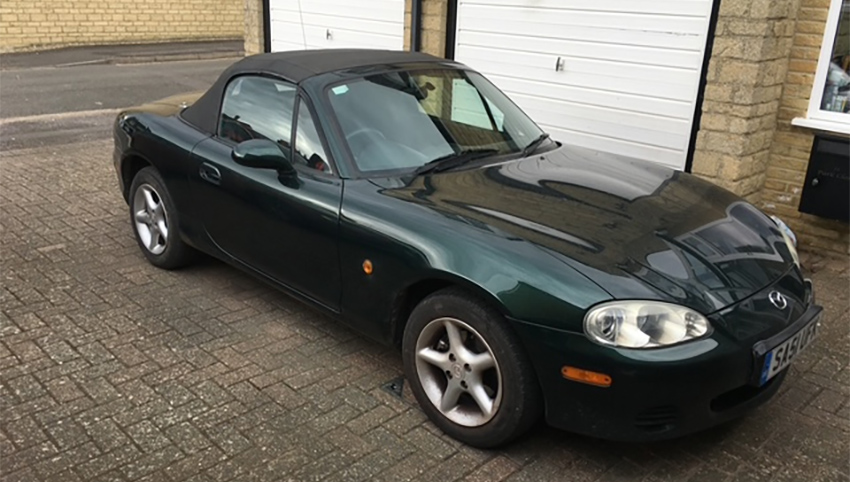
So which one has been the best. Everyone loves their first car especially if it is a Mini despite the rust and reliability problems. My first Renault 5 was a great car for its day- quirky, reliable, practical and fun. The V70 AWD was a really great car. Solid reliable with a surprising turn of speed, great economy and for a big car precise handling. Of the “Tart traps” the best would have been the Audi TT but with a convertible hard top. The problem with them was not the attractiveness of the traps but rather that the bait was no longer a well hung piece of beef (if ever it were thus) and was certainly well past its sell by date a resembled more a piece of manky scrag-end!
James Elwin